Hyperpigmentation Treatment in Newport Beach: Laser, AgeJET & Results
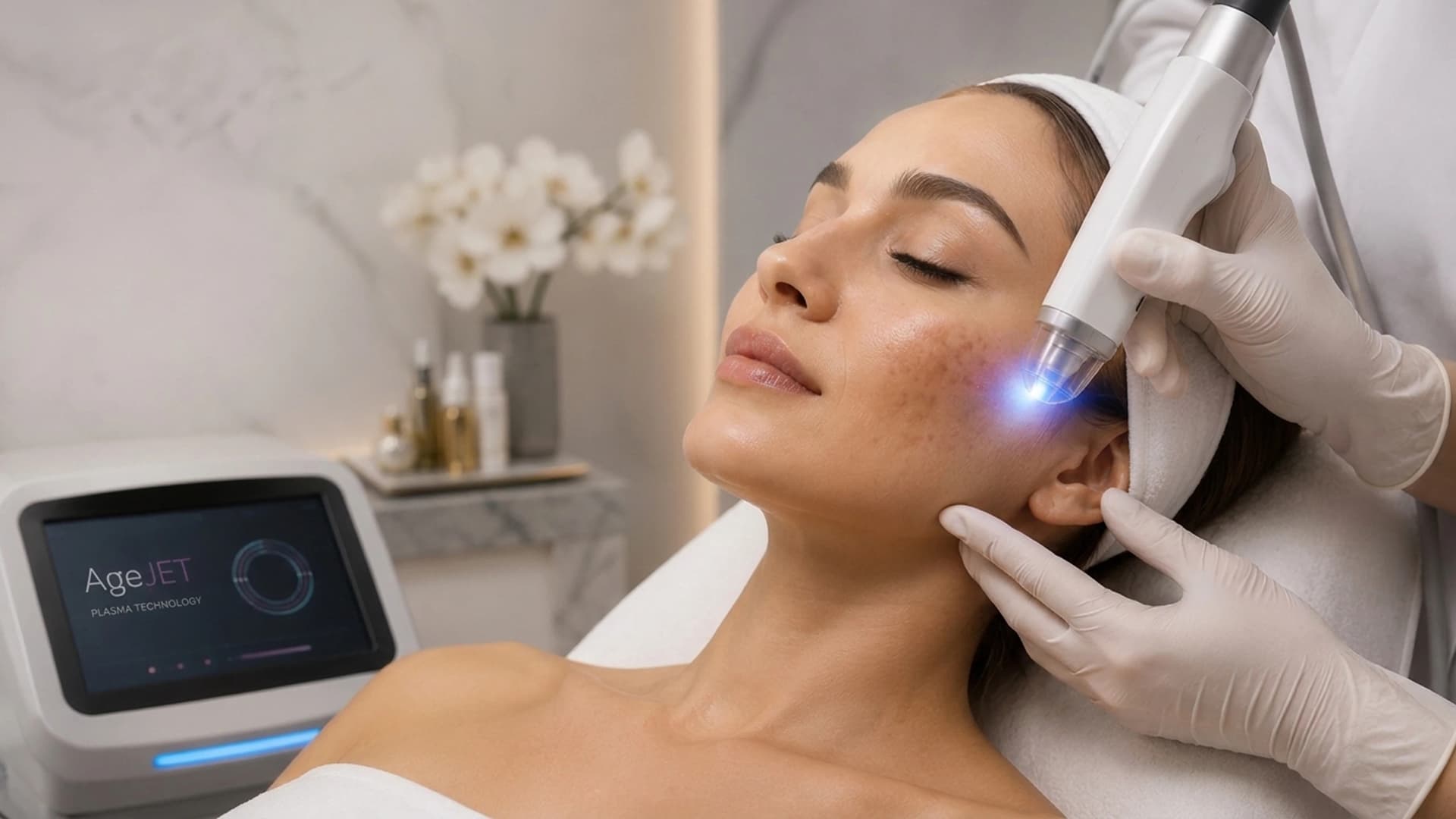
At Grey Aesthetics, the right modality matched to the right pigmentation type produces natural results that topical routines simply cannot replicate.
Hyperpigmentation treatment in Newport Beach uses advanced technologies like laser treatments and AgeJET plasma to target excess melanin beneath the skin’s surface, improving sun spots, melasma, post-inflammatory hyperpigmentation (PIH), and uneven skin tone. Unlike topical creams, professional treatments reach deeper layers of the skin to deliver longer-lasting results.
- Treatment options: Non-ablative laser treatments and AgeJET plasma target pigmentation while minimizing damage to surrounding skin.
- Best for: Sun spots, age spots, melasma, acne marks (PIH), and uneven skin tone.
- Results: Most patients notice improvement within 2–4 weeks, with continued fading over multiple sessions.
- Sessions: A series of 3–5 treatments, spaced 4–6 weeks apart, is typically recommended for optimal results.
- Downtime: Most non-ablative treatments involve minimal downtime, while AgeJET recovery varies depending on treatment intensity.
- Long-term success: Daily SPF 30+ and a personalized maintenance plan help prevent new pigmentation and maintain clearer, more even-toned skin.
What Causes Hyperpigmentation?
Melanocytes overproduce melanin and concentrate dark deposits in the epidermis or dermis, a condition with four main drivers: sun damage (solar lentigines), melasma triggered by hormonal fluctuations, post-inflammatory hyperpigmentation (PIH) following acne or injury, and chronic UV exposure that reactivates dormant melanocytes.
What Happens Beneath the Skin When Hyperpigmentation Develops?
The problem with over-the-counter brightening serums is architectural. Most actives, including vitamin C and kojic acid, work at the stratum corneum, the outermost dead-cell layer.
A 2023 PubMed review confirmed that pigment resistant to topicals often lives in the dermis, inside melanophages that have engulfed melanin granules deep below where a cream can reach. A serum cannot dissolve what it never contacts.
Why Do Topical Treatments Often Fall Short?
Topical skincare products can help fade mild surface pigmentation, but they’re often less effective for deeper or more stubborn discoloration. Conditions like melasma frequently involve both the epidermis and the deeper dermal layers of the skin.
A 2024 review published in PMC found that mixed-depth pigmentation responds best to treatments capable of reaching both layers rather than relying on topical products alone.
Because most creams work only on the skin’s surface, they can’t effectively target pigment trapped deeper in the dermis. That’s why many people see limited improvement with brightening serums despite months of consistent use.
Professional treatments such as laser therapy and AgeJET plasma are designed to reach deeper pigment deposits, helping break them down while stimulating healthier, more even skin renewal.
How Do Laser and AgeJET Treatments Remove Hyperpigmentation?
Professional-grade energy devices work through selective photothermolysis, a principle in which the laser or plasma wavelength is absorbed preferentially by melanin, converting light into heat that fragments pigment granules while leaving surrounding tissue intact.
Ablative vs. Non-Ablative: Choosing the Right Depth
Ablative lasers (fractional CO2, erbium) vaporise the outer skin layer to trigger full-thickness remodelling. Results are dramatic but carry 7 to 10 days of social downtime and a higher rebound risk in darker Fitzpatrick types.
Non-ablative platforms, including Q-switched Nd:YAG and picosecond devices, pass energy through the epidermis intact, shattering pigment granules below without removing surface tissue. Most Newport Beach patients with active schedules choose non-ablative first, and for good reason: the recovery window fits around real life.
How Does AgeJET Plasma Treat Hyperpigmentation?
AgeJET Plasma uses controlled nitrogen plasma energy to stimulate skin renewal and target pigmentation without damaging the skin’s surface. Unlike treatments that rely solely on heat, AgeJET delivers energy across multiple layers of the skin, helping improve hyperpigmentation, uneven skin tone, fine lines, texture, and skin laxity in a single treatment.
Because the epidermis remains intact, AgeJET offers a gentler approach with a lower risk of post-inflammatory hyperpigmentation (PIH), making it a suitable option for many patients with darker skin tones or those seeking effective skin rejuvenation with reduced downtime.
Grey Aesthetics offers AgeJET, a breakthrough plasma skin rejuvenation treatment that converts nitrogen gas into controlled plasma pulses. At Grey Aesthetics, AgeJET is often recommended for patients who want to improve pigmentation while also addressing uneven texture, fine lines, and early skin laxity in a single treatment plan.
Not Sure Which Treatment Is Right for You?
Every pigmentation pattern is different. So is every plan.
At Grey Aesthetics, every hyperpigmentation treatment begins with a comprehensive skin assessment. Book a complimentary consultation in Newport Beach.
When Will You See Results?
After laser or AgeJET treatment, the body gradually breaks down and clears the fragmented melanin through its natural healing process. Treated pigment may appear slightly darker during the first week before it flakes away, which is a normal part of recovery.
Most patients begin to notice a brighter, more even skin tone within 2-4 weeks of their first treatment. However, hyperpigmentation fades gradually, and the best results are typically achieved after a series of 3-5 treatments spaced 4-6 weeks apart.
More stubborn pigmentation, such as deeper melasma, may require 6-8 sessions depending on its depth, severity, and your skin’s response to treatment.
Because collagen remodeling and skin renewal continue between appointments, improvements often become more noticeable with each session. Your provider will adjust your treatment plan based on your pigmentation type, skin tone, and progress to achieve the safest and most effective results.
Laser vs. AgeJET Plasma Comparison
| Feature | Ablative Laser (CO2/Er:YAG) | Non-Ablative Laser (Nd:YAG/Picosecond) | AgeJET Plasma |
|---|---|---|---|
| Skin surface intact? | No | Yes | Yes |
| Downtime | 7–10 days | Minimal to none | 4–10 days (energy-dependent) |
| Pigmentation depth reached | Epidermal + dermal | Epidermal + upper dermal | Full skin structure |
| PIH risk in darker tones | Higher | Lower | Lower |
| Sessions typically needed | 1–3 | 3–5 | 1–3 |
| Best pigmentation match | Solar lentigines, epidermal PIH | Solar lentigines, mixed melasma, PIH | Mixed epidermal-dermal melasma, texture + pigment combined |
Why Choose Grey Aesthetics for Hyperpigmentation Treatment?
At Grey Aesthetics, every hyperpigmentation treatment begins with a comprehensive skin assessment to determine the type, depth, and underlying cause of your pigmentation.
Rather than relying on a single technology, we develop personalized treatment plans using advanced solutions such as AgeJET plasma and non-ablative laser treatments to target sun spots, melasma, post-inflammatory hyperpigmentation (PIH), and uneven skin tone.
By selecting the right treatment for your skin type and concerns, we aim to maximize pigment reduction while minimizing downtime and the risk of post-inflammatory hyperpigmentation. Whether you need a standalone treatment or a combination approach, our goal is to deliver natural-looking, long-lasting results through evidence-based regenerative care.
A treatment plan built around your pigmentation.
Our team evaluates the type, depth, and cause of your pigmentation before recommending a single session. The result looks like clearer, more even-toned skin —without unnecessary downtime.
Comprehensive skin assessment before every treatment
AgeJET plasma and non-ablative laser options
Complimentary consultation — no obligation to book
What Should You Expect During Treatment and Recovery?
The patient experience follows a predictable arc, and knowing it removes most of the anxiety.
How Should You Prepare Before Your Appointment?
Avoid unprotected sun exposure for at least two weeks prior. Retinoids and exfoliating acids should be paused five to seven days before treatment; they thin the epidermis and can amplify thermal sensitivity. Arrive with clean skin, no makeup, no SPF.
A topical numbing cream is typically applied 20 to 30 minutes before the session begins.
What Happens During the Treatment?
Most non-ablative laser treatments take 10–30 minutes, depending on the size of the treatment area. Patients typically describe the sensation as a series of warm snaps or the light flick of a rubber band against the skin.
For added comfort, a topical numbing cream or cooling device may be used when needed.
During an AgeJET Plasma treatment, controlled nitrogen plasma energy is delivered to the skin as brief, gentle heat pulses. After the procedure, it’s normal to experience mild redness and warmth similar to a light sunburn. These effects usually subside over the following days as your skin begins its natural healing and renewal process.
How Are Treatments Adjusted for Darker Skin Tones?
One of the more consequential decisions in any hyperpigmentation protocol is how to approach Fitzpatrick IV through VI skin. At Grey Aesthetics, these patients typically begin at a lower fluence than the device’s standard starting point, and session intervals are extended to six weeks rather than four.
The reasoning is straightforward: darker skin contains more baseline melanin, so the thermal margin between fragmenting pigment deposits and stimulating fresh melanin production is narrower. Starting conservatively and reading the skin’s response between sessions produces steadier clearance than pushing energy levels early.
A patient presenting with post-inflammatory hyperpigmentation on Fitzpatrick V skin, for example, will often see the most reliable progress through three to four lower-fluence non-ablative sessions before any consideration of higher-energy passes.
This approach aligns with guidance from the American Academy of Dermatology on managing laser-induced PIH risk in patients with darker complexions, and with findings published in Lasers in Surgery and Medicine on sequential low-fluence protocols for dermal melasma.
What Is Recovery Like After Treatment?
Recovery depends on the treatment used and the intensity of your personalized plan. Non-ablative laser treatments typically involve little to no downtime, allowing most patients to return to work and normal daily activities the same day.
AgeJET Plasma and ablative laser treatments generally require 4-10 days of recovery, during which mild redness, swelling, and peeling are expected as the skin heals.
The most important part of recovery is protecting your skin from the sun. Daily use of a broad-spectrum SPF 30 or higher helps prevent new pigmentation from developing and preserves your treatment results.
Your provider will also recommend a gentle skincare routine and temporary avoidance of direct sun exposure, exfoliants, and other potentially irritating products while your skin recovers.
How Can You Prevent Rebound Hyperpigmentation?
Rebound hyperpigmentation is the outcome nobody warns you about clearly enough. It happens when a high-energy session inflames the skin and the melanocytes respond by producing more pigment, exactly what you came to eliminate.
Choosing a provider who calibrates energy conservatively for your Fitzpatrick type and builds in adequate intervals between sessions is the single most consequential decision in this process. That clinical specificity is what separates a natural-results outcome from a frustrating plateau.
How Do You Choose the Right Hyperpigmentation Clinic?
Run this check on your own shortlist before booking: ask which device will be used, whether it’s FDA-cleared for your skin type, and who performs the treatment. The answers tell you more than any review count.
The right treatment plan should be based on the type, depth, and cause of your pigmentation rather than a one-size-fits-all approach.
At Grey Aesthetics, every treatment begins with a personalized consultation to determine the most effective approach for your skin. For complementary treatments, the team also offers LaseMD Ultra skin resurfacing, neuromodulators in Newport Beach and Keravive scalp treatment in Newport Beach for clients addressing multiple concerns in a single visit.
If you’ve identified your pigmentation type and want a treatment plan built around your specific skin tone and depth of concern, contact the Grey Aesthetics team directly for a consultation that answers your exact question.
Real Results, Real People
See what’s possible with a precise pigmentation protocol.
Our provider builds a custom protocol that treats your specific pigmentation type and skin tone. The consultation is complimentary.
Frequently Asked Questions
Is professional hyperpigmentation treatment permanent, or will pigment return?
Can hyperpigmentation be treated year-round in Southern California?
Which skin types see the best results?
How do I choose the right hyperpigmentation clinic in Newport Beach?
What is AgeJET plasma, and how is it different from Jet Plasma?
Keep Reading
Related Articles

AgeJET Treatment in Newport Beach: Benefits & Results
Nitrogen plasma technology that rebuilds collagen, tightens skin, and improves acne scars without surgery.
Best Treatments for Skin Tightening Without Surgery
RF microneedling, plasma therapy, TriLift, and laser resurfacing compared.
RF Microneedling in Newport Beach: Before & After Results, and Recovery Guide
How many sessions you need, recovery time, and what makes RF microneedling effective for acne scars and skin laxity.
Start Here
Ready to book your hyperpigmentation consultation?
Schedule a personalized skin assessment at Grey Aesthetics Newport Beach to determine the type, depth, and cause of your pigmentation and build the right treatment plan.